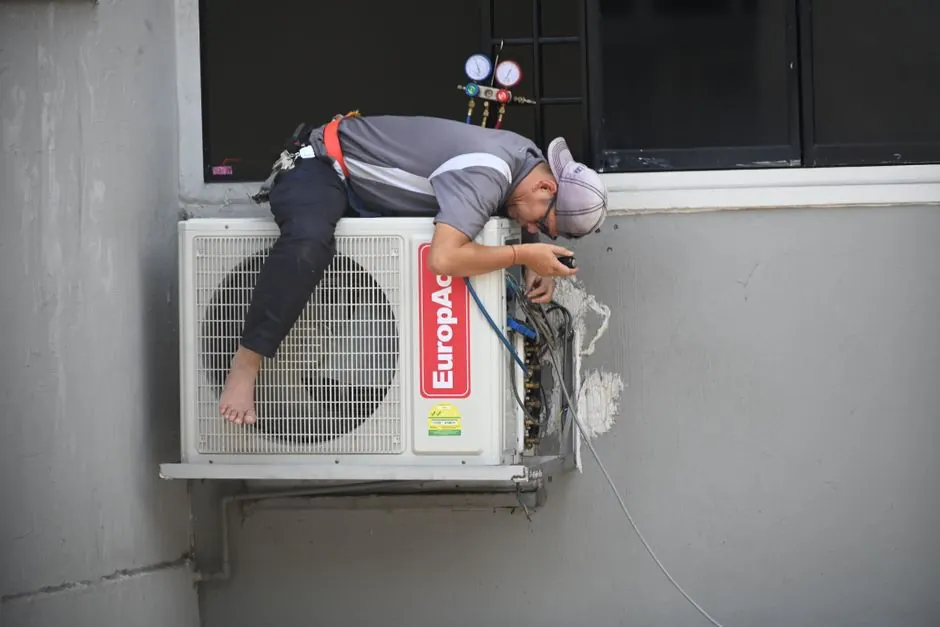
If your AC is not cooling in Greenville SC, the most likely culprits are a clogged air filter, low refrigerant from a slow leak, a failed capacitor, a frozen evaporator coil, or a dirty outdoor condenser coil. Nine times out of ten, the fix is one of those five - and eight of the nine are repairable the same day. This post walks through every cause we see across Greenville County, what each repair costs in 2026, and the ten-minute check you can run yourself before you call anyone.
The short answer: why your AC stopped cooling in Greenville
Why is my AC not cooling in Greenville SC is a question with a mechanical answer, not a mysterious one. An air conditioner has exactly one job: move heat from inside your house to outside it. Anything that blocks that heat transfer - restricted airflow, a refrigerant leak, a dead electrical component, or a coil caked in pollen - shows up as warm air at your vents.
Greenville makes this worse than most markets. We run our systems from April through October, often 8 to 10 hours a day, and the outdoor units sit in humidity that averages 70 percent. That combination wears capacitors, corrodes condenser fins, and pushes refrigerant leaks to the surface faster than in drier climates.
Before you spend a dollar, check the filter. A clogged filter is the single most common reason for AC not cooling repair Greenville SC calls we run, and it costs you nothing to rule out.
How a Greenville AC system actually cools your house
A central air conditioner is a closed loop of refrigerant that shuttles heat from your indoor coil to your outdoor condenser. The compressor pressurizes refrigerant gas, the condenser coil dumps that heat into the outside air, and the evaporator coil inside your air handler absorbs heat from the air your blower pushes across it.
Every part of that loop has to work. If the blower is weak, the coil ices. If the capacitor that starts the compressor is dead, nothing runs. If the refrigerant charge is 10 percent low, the system still runs but only cools the house to 78 or 80 degrees instead of 72.
That is why "AC not cold enough Greenville" almost never has a single dramatic cause. It is a slow degradation - a little airflow lost here, a little charge lost there - until one July afternoon the house just will not drop below 80.
If you are not sure whether your system is a standard split system, a heat pump, or a ductless mini-split, our team handles all three. We do central AC repair Greenville SC on the split systems that dominate neighborhoods like Augusta Road and North Main, and we service ductless units in the older mill houses and downtown condos where running new ductwork is not practical.
The 9 most common reasons an AC stops cooling in Greenville SC
These are ranked by how often we find them on real service calls in Greenville County, not by how dramatic they sound.
1. A clogged or wrong-size air filter
Filters in Greenville homes load up fast because we run the fan so many hours. A 1-inch pleated filter can choke in 30 to 45 days during peak summer. When airflow drops, the evaporator coil gets too cold and freezes, and a frozen coil passes almost no air. Change it monthly from June through September.
2. Low refrigerant from a slow leak
An AC does not "use up" refrigerant. If the charge is low, there is a leak - usually at a Schrader valve, a brazed joint, or the evaporator coil. A system that is 10 to 15 percent low will still run but will only pull the house down to 78 or 80 degrees. Topping it off without finding the leak is a waste of money; the charge will be gone again in a season.
3. A failed run capacitor
The run capacitor gives the compressor and condenser fan motor the torque to start. Greenville heat kills them. A bulging or leaking capacitor is a 15-minute, low-cost fix, and it is one of the most common reasons an outdoor unit hums but does not spin. We replace dozens of these every summer.
4. A frozen evaporator coil
A frozen coil is a symptom, not a disease. It is almost always caused by low airflow (dirty filter, weak blower) or low refrigerant. You will see ice on the copper lines at the air handler, or the system will run constantly and blow barely-cool air. Turn the system off, run the fan only for two to three hours to thaw it, then find the root cause.
5. A dirty outdoor condenser coil
Greenville's pollen season in March and April packs the condenser fins with yellow dust. Add grass clippings and cottonwood in May, and the coil cannot reject heat. The system runs, the compressor gets hot, and the house slowly warms. A coil cleaning every spring is the cheapest efficiency gain you can buy.
6. A thermostat that is reading wrong
If your thermostat is mounted on an exterior wall, near a lamp, or in a hallway with a supply vent blowing on it, it will read 74 when the room is 80. Check the reading against a separate thermometer. Smart thermostats also drift after firmware updates - a factory reset fixes more of these than you would expect.
7. A clogged condensate drain line
Greenville's humidity means your AC pulls 5 to 15 gallons of water a day out of the air. That water drains through a PVC line that algae loves. When it clogs, the float switch shuts the system down to prevent a flood. If your AC runs for 10 minutes and stops, check the drain pan for standing water.
8. A failing compressor
The compressor is the heart of the system and the most expensive part. Symptoms include a loud clicking, a breaker that trips repeatedly, and zero cooling with the outdoor fan running. On a system under 10 years old, a compressor replacement often makes sense. On a 15-year-old unit, we usually recommend weighing repair against replacement.
9. Undersized or leaking ductwork
If the air leaving your vents is 15 to 20 degrees cooler than the air at the return, your equipment is fine and your ducts are the problem. Greenville attics hit 130 degrees in July. Leaky ductwork in that attic loses 20 to 30 percent of your cooling before it ever reaches a room.
What to do if AC is not cooling Greenville: a 10-minute homeowner check
Run these in order before you call anyone. They cost nothing and they solve a surprising share of warm-air complaints.
- Check the filter. Hold it up to a light. If you cannot see through it, replace it.
- Check the breaker. Both the indoor air handler and the outdoor condenser have their own breakers. Reset any that are tripped.
- Check the float switch. Look at the drain pan under the air handler. Standing water means a clogged drain line.
- Check the outdoor unit. Is the fan spinning? Is the coil covered in cotton or grass? Is there ice on the copper line?
- Check the thermostat. Set it to 70 and confirm the system actually calls for cool. Replace the batteries if it takes them.
- Check the vents. Make sure no supply registers are closed and no return grilles are blocked by furniture.
If all six check out and the air at the vents is still warm, you have a refrigerant, capacitor, or compressor issue. That is when you stop and call us. Our same day AC repair Greenville SC gets a technician to most Greenville addresses within a few hours, and we carry the capacitors, contactors, and common parts on the truck so most repairs finish on the first visit.
AC not cooling at night Greenville: why it feels worse after dark
AC not cooling at night Greenville is usually a different failure than daytime warm air. When the outdoor temperature drops below 75 after sunset, a system that is 10 to 15 percent low on refrigerant can actually freeze its indoor coil. The coil ices over, airflow stops, and the house gets stuffy by 10 p.m.
You will notice it as a pattern: the house cools fine until about 8 p.m., then the air goes lukewarm and the system runs nonstop. If you see that pattern, turn the system off, switch the fan to ON to thaw the coil, and call for a refrigerant leak test the next morning. Running it frozen will eventually kill the compressor.
Homes in the older parts of town - the bungalows off Pendleton Street, the mill houses in West Greenville - tend to see this more because their ductwork is undersized for modern equipment. If that sounds like your house, we do residential AC repair Greenville SC and we will measure static pressure at the air handler to confirm whether the ducts are strangling the system.
AC not cooling after power outage Greenville: what to check first
AC not cooling after power outage Greenville almost always traces back to one of three things: a tripped breaker, a blown capacitor from the surge, or a compressor that went into lockout. Duke Energy outages in the summer are usually short, but the surge when power returns is what damages equipment.
Start at the breaker panel. If the AC breaker is tripped, reset it once. If it trips again immediately, stop - you have a short or a failing compressor, and repeated resets will make it worse. If the breaker holds but the outdoor unit hums without the fan spinning, that is a capacitor, and it is a fast fix.
If the system is completely silent and the thermostat is blank, check the float switch and the indoor unit's service switch. Both get bumped during outages more often than people realize.
What AC repairs cost in Greenville in 2026
Typical 2026 pricing in the Greenville area runs from about $85 for a diagnostic visit to $2,400 for a compressor replacement, depending on the part and the system. Here is what we actually charge, and what you should expect from any honest AC company in town.
- Diagnostic and system check: $79 to $129, often waived when you approve the repair.
- Capacitor replacement: $180 to $350 installed.
- Contactor replacement: $150 to $300 installed.
- Condensate drain clearing: $125 to $225.
- Refrigerant leak search and repair: $350 to $900, plus refrigerant.
- Refrigerant recharge (R-410A): $75 to $150 per pound, and most systems need 2 to 5 pounds.
- Evaporator coil replacement: $900 to $1,800 installed.
- Condenser fan motor: $400 to $700 installed.
- Compressor replacement: $1,400 to $2,400 installed.
If a quote for a capacitor comes in at $600, get a second opinion. If a quote for a compressor comes in at $900, ask what brand and what warranty. We give you the number before we start, and we do not add line items after the fact.
Common mistakes Greenville homeowners make with a warm AC
The mistakes we see most often turn a $200 repair into a $2,000 one. Watch for these.
- Running a frozen system. If the coil is iced, shut it off. Running it frozen forces the compressor to work against liquid refrigerant and can destroy it.
- Adding refrigerant without finding the leak. A recharge without a leak repair is a rental. The charge will be gone again within a season.
- Replacing the thermostat first. A thermostat is rarely the cause. Diagnose the equipment before you spend $250 on a smart thermostat.
- Ignoring the filter for three months. In a Greenville summer, a 1-inch filter is done at 30 to 45 days. Set a phone reminder.
- Letting the outdoor coil go two seasons without a wash. Pollen and cottonwood cut efficiency by 5 to 10 percent and shorten compressor life.
- Calling a general handyman for refrigerant work. Refrigerant handling requires EPA Section 608 certification. Ask for it.
When to call a professional
Call a licensed AC technician when the air at your vents is more than 15 degrees warmer than the thermostat setting, when the breaker trips twice, when you see ice on the copper lines, or when the outdoor unit hums but does not spin. Those four symptoms point to refrigerant, electrical, or compressor problems that you cannot safely diagnose with a multimeter from the hardware store.
Greenville AC Repair Pros is a locally owned AC repair company serving Greenville and the surrounding county. We run same-day and after-hours calls, we stock the parts that fail most in our climate, and we tell you the price before we touch the system. If you want a company that has actually worked on the equipment in Greenville homes - not a call center three states away - we are the ones to call.
Frequently Asked Questions
Why is my AC not cooling in Greenville SC?
The top causes in Greenville are a clogged air filter, low refrigerant from a leak, a failed run capacitor, a frozen evaporator coil, and a dirty outdoor condenser coil. Greenville's long cooling season and high humidity accelerate all five. Start by checking the filter and the breaker, then call a pro if the air is still warm.
What causes AC to stop cooling in Greenville?
Heat, humidity, and pollen. Capacitors fail from the run hours, condenser coils clog with spring pollen, and refrigerant leaks surface faster in a system that runs 8 to 10 hours a day from April through October. Most Greenville cooling failures trace back to one of those three stressors.
How do I fix my AC not cooling in Greenville?
Change the filter, reset the breakers, check the drain pan for standing water, and confirm the outdoor fan is spinning. If the air at the vents is still warm after those four steps, the issue is refrigerant or electrical and needs a licensed technician with gauges and a multimeter. Most repairs take 1 to 3 hours.
When should I call an AC pro in Greenville?
Call when the breaker trips twice, when you see ice on the copper lines, when the outdoor unit hums without spinning, or when the house will not drop below 78 degrees. Those four symptoms point to compressor, capacitor, or refrigerant problems. Same-day service is usually available in Greenville.
Can I just add refrigerant to fix my AC?
No. An AC is a sealed system - if the charge is low, there is a leak. Adding refrigerant without repairing the leak is a temporary fix that lasts one season at most. A proper repair includes a leak search, a repair, and a recharge with the correct weight of refrigerant.
Get help with AC Repair in Greenville
If your AC is blowing warm air and the filter and breaker checks did not fix it, we can be at your door today. Call Greenville AC Repair Pros at (903) 627-1334 and we will diagnose the system, give you the price up front, and get your house cool again - usually on the first visit.